Pune’s Rise as an IT and Business Hub


Table of Contents
- From Pune Education Hub to Technology Hub
- The Rise of the Pune IT Sector
- Pune Business Hub: From IT Parks to a Diversified Economy
- Pune Infrastructure Development Is Reshaping Property Demand
- Pune Real Estate Development Is Following Employment
- What the Numbers Say About Pune’s Housing Market
- Key Growth Corridors: Where Pune’s IT Economy Meets Housing
- The New Buyer: Home, Workplace and Lifestyle in One Ecosystem
- How VTP Realty Fits Into Pune’s Real Estate Development Story
- What Should Buyers Actually Look For?
- What Pune’s Next Decade Could Look Like
Pune’s transformation from the “Oxford of the East” into a major technology, manufacturing and business destination did not happen overnight. Its strongest advantage has always been its talent.
Prestigious educational institutions created a deep pool of engineers, researchers and management professionals, which in turn attracted technology companies, automotive giants, global capability centers and startups.
Today, the Pune IT hub is no longer confined to a few office parks. It has expanded into a wider economic ecosystem, influencing where people live, where businesses locate, how infrastructure is planned and, ultimately, how Pune’s real estate market develops.
For homebuyers and investors, this matters. A property’s future is increasingly linked not simply to its address, but to the employment, infrastructure, and commercial ecosystem developing around it.
From Pune Education Hub to Technology Hub
Pune’s identity as an education hub remains central to its economic success. Institutions such as Savitribai Phule Pune University, COEP Technological University, Symbiosis, and IISER have helped create a sustained pipeline of technical, scientific, and management talent.
This depth of education gave technology companies a reason to establish and expand operations in the city. Instead of building a talent ecosystem from scratch, companies could tap into graduates already familiar with engineering, software, research, and emerging technologies.
That connection between education and employment has become one of Pune’s biggest structural advantages. Students arrive for education, many stay for employment, and a portion eventually become homebuyers.
This is one reason Pune’s real estate demand has a stronger end-user foundation than markets driven primarily by speculative investment.
The Rise of the Pune IT Sector
The next phase was the rapid expansion of the Pune IT sector. Planned employment destinations began changing the geography of the city, such as:
Major Tech Parks:
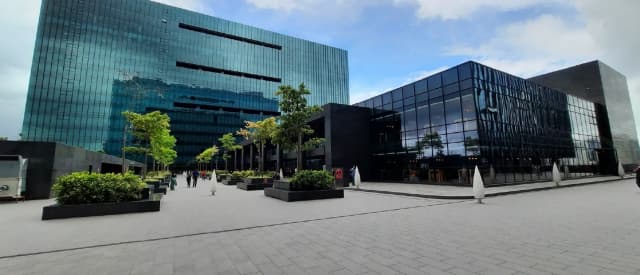
Rajiv Gandhi Infotech Park in Hinjawadi became one of Pune’s defining technology clusters. Magarpatta City established a major employment and mixed-use destination in Hadapsar, while EON IT Park and the wider Kharadi ecosystem strengthened East Pune’s position as a technology and commercial hub.
Economic Diversification:
The result was an increasingly diversified economy. IT and software services grew alongside Pune’s established automotive and manufacturing base, creating multiple employment engines rather than leaving the city dependent on a single industry.
That distinction is important for real estate. A city with several employment pillars can generate housing demand across different income groups and locations.
Recent Investments:
The growth engine continues to scale; recent national economic frameworks and a ₹5,000 crore allocation in the Union Budget target Pune for broader regional development across nearly 7,000 square kilometers, reports The Indian Express.
Pune Business Hub: From IT Parks to a Diversified Economy
Pune has gradually evolved from primarily an outsourcing destination into a broader business hub, with technology, automotive, engineering, manufacturing, fintech, healthtech, edtech, and global capability centers contributing to economic activity.
The Pune startup ecosystem reflects this transition.
StartupBlink’s 2026 rankings place Pune fourth among Indian startup ecosystems and 62nd globally. Operating expenses and living costs are estimated to be around 30% to 40% lower than in Mumbai and Bengaluru, giving startups and growing businesses more room to scale.
The attraction is straightforward: a large talent pool, established technology infrastructure, and a relatively favorable cost base compared with Mumbai and Bengaluru make Pune an attractive environment for businesses that want to build and scale.
Startup and coworking activity is particularly visible around Hinjawadi, Baner-Balewadi, Kharadi, and Magarpatta. Incubation and innovation networks further strengthen the ecosystem.
For real estate, this creates a different kind of demand. Entrepreneurs, young professionals, senior technology employees, and growing businesses do not all seek the same property. Some want compact homes close to work; others want larger residences, premium amenities, or flexible workspaces.
This is where Pune commercial real estate also becomes important. As businesses expand, demand extends beyond conventional office space into coworking, high-street retail, managed offices, and mixed-use developments, creating a broader employment and consumption ecosystem around residential neighborhoods.
Pune Infrastructure Development Is Reshaping Property Demand
Employment creates demand, but infrastructure determines how far that demand can spread.
This is where Pune infrastructure development becomes critical to the city’s real estate story.
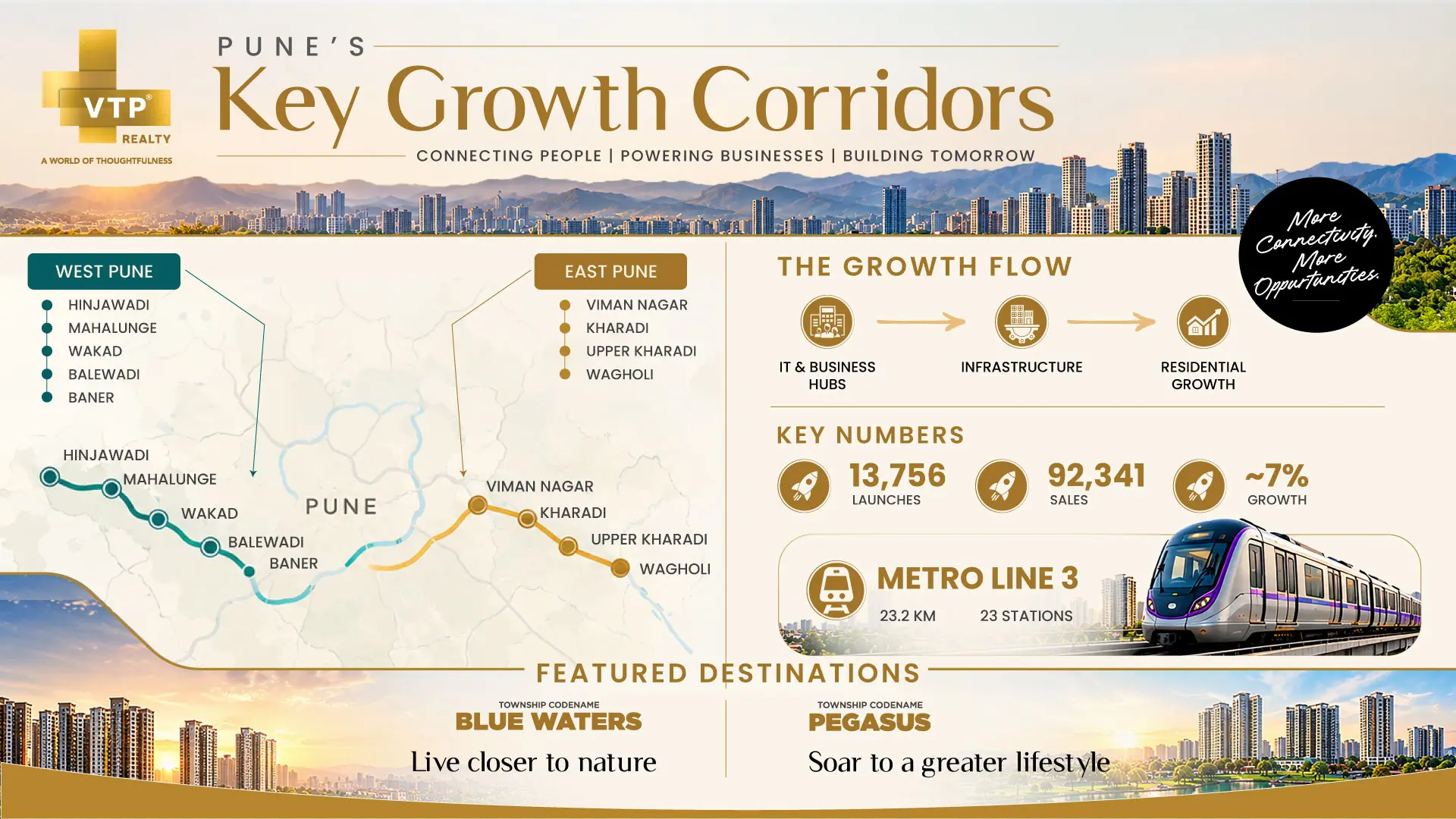
The Pune Metro is gradually improving connectivity between established urban centers and employment corridors. Metro Line 3, connecting Hinjawadi with Shivajinagar, is particularly significant because it directly addresses connectivity around one of Pune’s largest IT clusters. The planned elevated corridor spans about 23.2 km with 23 stations.
Road projects, ring-road development, and improvements in regional connectivity are similarly changing the investment equation.
For a property purchase, RERA-registered project timelines, actual access roads, existing commute times, and the status of promised infrastructure deserve more weightage.
Pune Real Estate Development Is Following Employment
The connection between jobs and housing is visible across Pune’s major corridors.
Hinjawadi, Wakad, Baner, Balewadi, and the wider north-west corridor have benefited from the expansion of Pune's IT sector. Kharadi, Viman Nagar and Upper Kharadi have emerged as important employment and residential destinations in East Pune.
This has encouraged a shift in Pune real estate development from isolated residential buildings to larger communities that combine housing, amenities, retail, and everyday conveniences.
The logic is simple—when a family spends a significant part of its day commuting, a home that reduces travel while providing essential amenities becomes more valuable than one that is merely larger.
That is why concepts such as walk-to-work communities, integrated townships, and mixed-use developments are becoming increasingly relevant to Pune’s growth.
What the Numbers Say About Pune’s Housing Market
The current market also tells an important story.
As per Hindustan Times, Pune also recorded 13,756 residential launches in Q2 2026 alone, the highest quarterly supply in three years. Annual launches reached 1,01,085 units, reflecting developers' continued confidence in the city’s underlying housing demand. At the same time, Pune recorded 92,341 housing sales in the 12 months ending June 2026, up from 86,666 units in the previous 12-month period, representing approximately 7% annual growth.
This is a market with healthy underlying demand, but not one where every project automatically makes a good investment.
For buyers, this information is useful. It means there is choice, but also a reason to compare projects carefully.
The questions should be practical:
- Is the project RERA registered?
- Who is the developer, and what is the delivery track record?
- How close is the property to established employment?
- What is the actual commute today?
- Is the surrounding infrastructure already operational?
- Does the project offer usable amenities or simply a long amenity list?
- Is the configuration suitable for the local buyer and rental market?
Key Growth Corridors: Where Pune’s IT Economy Meets Housing
The NH-4 Bypass and north-west corridor, covering Balewadi, Baner, Wakad, Hinjawadi, Punawale and Tathawade, accounts for an estimated 40% to 50% of new residential supply. The concentration is not accidental. This belt combines access to employment, large-scale residential development, and improved connectivity.
East Pune: Kharadi, Viman Nagar and Upper Kharadi
East Pune has become one of the city’s strongest employment-led residential markets. Kharadi benefits from major commercial developments and IT employment, while Viman Nagar offers proximity to established business districts, the airport and mature social infrastructure.
Upper Kharadi and Wagholi represent the next layer of expansion, where larger land parcels allow developers to create bigger residential communities.
For investors, the important distinction is between established demand and future potential. Kharadi offers a mature employment ecosystem; emerging areas require greater scrutiny of infrastructure, delivery timelines, and actual tenant demand.
West Pune: Hinjawadi, Wakad, Baner and Balewadi
West Pune remains central to the Pune technology hub story.
Hinjawadi is anchored by Rajiv Gandhi Infotech Park, while Wakad, Baner and Balewadi have developed into residential, retail and social infrastructure extensions of the employment corridor.
This belt continues to attract significant residential supply because established IT parks, SEZs, and expanding technology campuses create a large pool of potential end users and tenants.
The infrastructure story is equally important. Metro connectivity, ring-road projects, road network improvements, and Pune’s connection to Mumbai are gradually reducing logistical barriers between employment centers and residential areas. But buyers should distinguish among operational infrastructure, infrastructure under construction, and infrastructure still in the proposal stage.
For professionals working in Hinjawadi, the value proposition is increasingly about reducing commute friction while retaining access to schools, healthcare, retail, and lifestyle infrastructure.
The New Buyer: Home, Workplace and Lifestyle in One Ecosystem
The modern Pune home buyer is increasingly evaluating a property through the lens of time.
A 20-minute reduction in the daily commute can be more meaningful than another amenity on a brochure. A nearby grocery store can matter more than a distant retail complex. A proper work-from-home space can be more valuable than an oversized formal living area for a hybrid-working professional.
This is why newer developments are incorporating home-office zones, smart-home features, digital infrastructure, wellness spaces, and larger community amenities.
The shift is not simply about luxury. It is about making urban living more functional.
How VTP Realty Fits Into Pune’s Real Estate Development Story
With more than four decades of legacy within the VTP Group, VTP Realty has built its development strategy around large-format residential projects, mega-townships, and what we call Maximum Livable Area (MLA) homes.
Its approach is closely aligned with the changing geography of Pune’s employment corridors. Instead of treating housing as a standalone building, the focus is increasingly on creating larger communities around the places where people work and spend their time.
VTP’s multi-acre townships are also positioned to benefit from broader corporate expansion and infrastructure development, including Pune Metro Line 3 and the Pune-Bangalore Highway expansion. For buyers, however, the sensible approach is to evaluate the current accessibility and RERA-registered project details alongside the future infrastructure story.
VTP Realty Building Around Pune’s IT Corridors
VTP’s township developments are positioned across key employment-led growth areas:
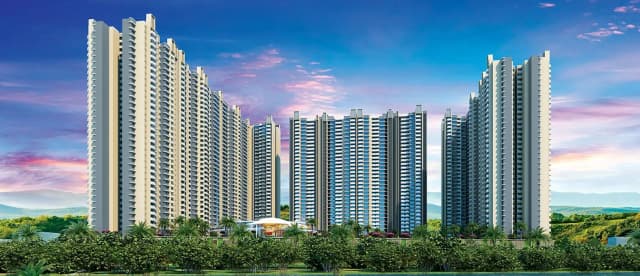
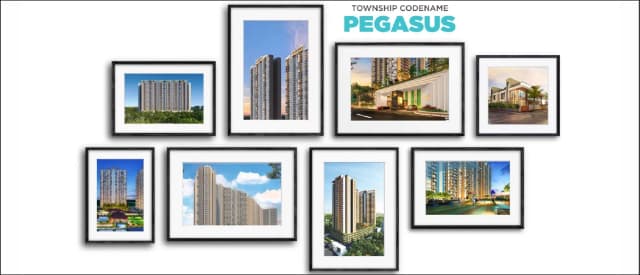
- In East Pune, Township Codename Pegasus spans more than 165 acres and is positioned in the New Kharadi-Manjari belt, close to major commercial destinations such as EON Free Zone and the World Trade Center. Its location targets professionals seeking an alternative to the congested Nagar Road commute while remaining connected to East Pune’s employment ecosystem.
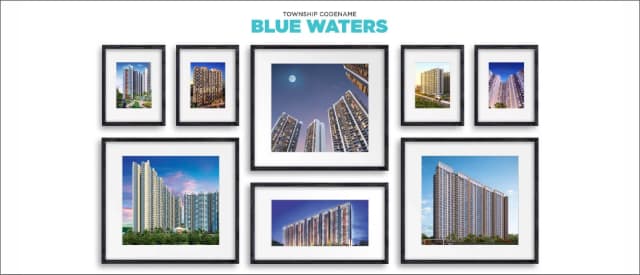
- In West Pune, VTP’s developments around Mahalunge and Hinjawadi sit within the wider technology corridor and the emerging Maan-Mahalunge growth belt. Located in the Hi-Tech city of Mahalunge, Codename Blue Waters is positioned to serve the workforce associated with the Hinjawadi employment ecosystem.
This strategy reflects an important principle in Pune real estate: proximity to employment is not merely about rental demand. It can also influence long-term end-user demand, social infrastructure, and how quickly surrounding neighborhoods mature.
Read more: How VTP Realty Is Shaping Pune and Redefining Urban Living
Designing for the Hybrid Workforce
The traditional idea of a home has changed with hybrid work.
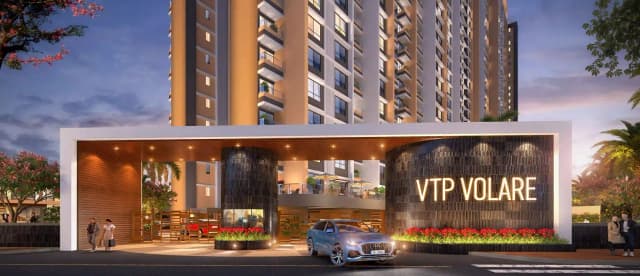
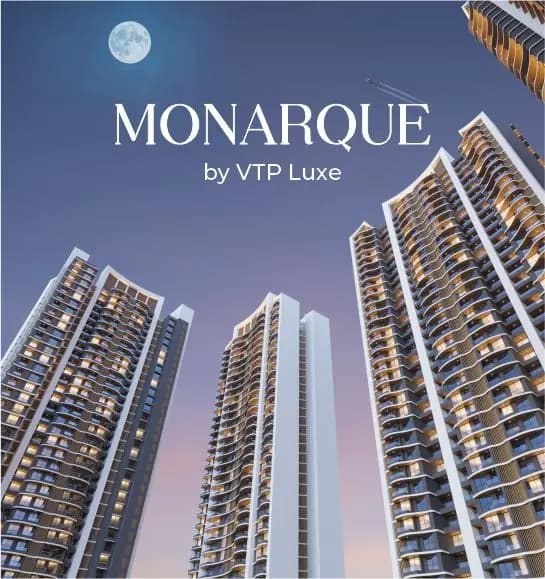
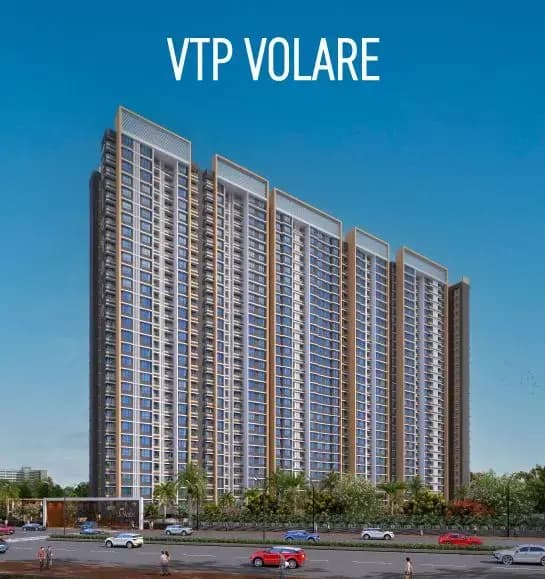
VTP’s approach mirrors the lifestyle and financial habits of Pune’s corporate and technology workforce by combining residential planning with features suited to hybrid working. Projects in Hinjawadi such as VTP Volare and VTP Monarque incorporate spaces and features designed to support work-from-home lifestyles.
The thinking is practical: if professionals are spending more time at home, the home needs to work harder. Dedicated work zones, smart-home features, digital infrastructure, and community amenities can make a meaningful difference to everyday usability.
Mixed-Use Development and Everyday Convenience
Large townships can also strengthen the local economy by integrating retail and commercial spaces.
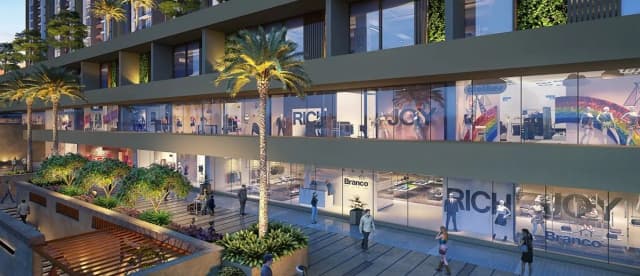
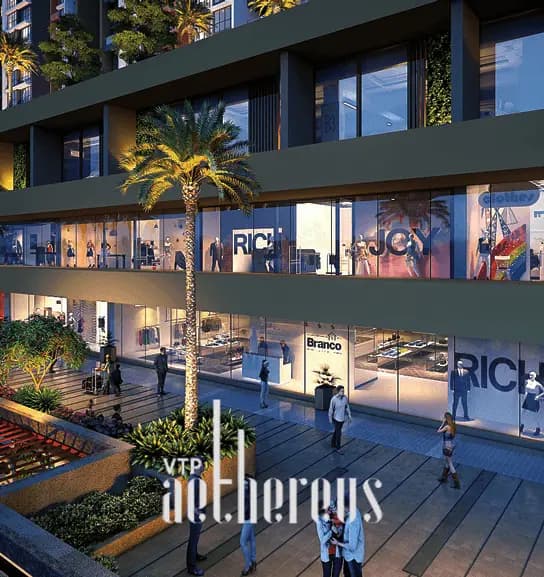
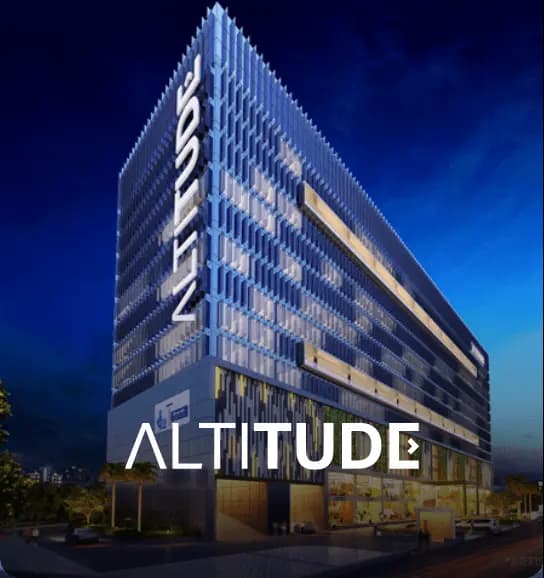
VTP Realty’s future-ready projects, such as VTP Aethereus High Street in Mahalunge and VTP Altitude, a commercial project in Wakad, reflect this mixed-use approach, bringing shopping, dining, and everyday conveniences closer to residential communities.
This model connects Pune commercial real estate with residential development. When offices, retail, dining, and essential services develop alongside housing, the result is a more self-sufficient urban ecosystem rather than another isolated residential cluster.
The idea is simple: as Pune’s employment corridors grow, residential development needs to grow alongside them, not just add apartment towers.
Read more: VTP Realty’s vision for urban development in Pune
What Should Buyers Actually Look For?
The phrase “high-growth corridor” can be tempting, but experienced buyers know that location alone does not guarantee returns.
Rental demand is strongest where a reliable tenant base exists. Capital appreciation is more sustainable where employment, infrastructure, civic amenities and housing demand develop together.
That is why projects located near established or emerging employment clusters can have a strong underlying demand story. VTP’s use of Tunnel Form Technology (TFT) is designed to support faster construction cycles, although buyers should still independently verify project-specific RERA timelines, approvals, and possession commitments.
For an investor, access to employment and large-scale community development can also strengthen the rental proposition.
Ultimately, the best property is the one where location, developer credibility, construction quality, connectivity, livability, and demand align.
| Region / Corridor | Core Mega-Township | Marquee Projects | Adjacent Corporate/IT Hubs |
|---|---|---|---|
| Pune West (Mahalunge) |
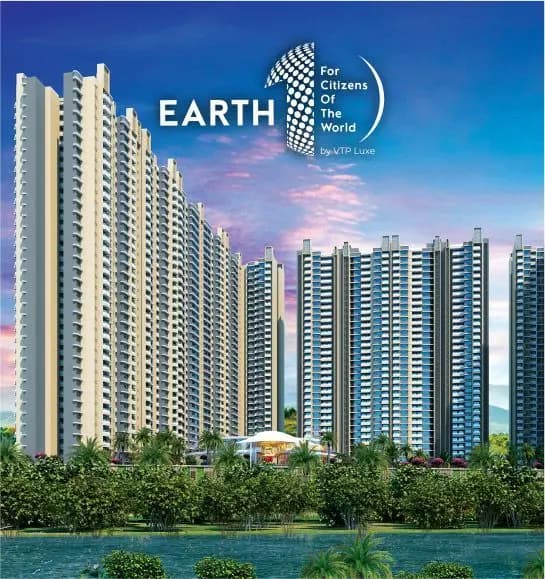
Township Codename Blue Waters & Independent Clusters | VTP Codename Never Before, Earth 1 by VTP Luxe, VTP Aethereus High Street | Baner-Balewadi commercial high streets, Hinjawadi Phase 1 tech boundary, Wipro LTD, TATA Technologies, Infosys Phase-1 |
| Pune West (Hinjawadi) |
Township Codename Blue Waters & Independent Clusters | VTP Volare, VTP Bellissimo, Monarque by VTP Luxe | Located minutes away from major employment centers, and positioned along the Aundh-Baner-Balewadi-Wakad smart development corridor. |
| Pune West (Baner-Sus Road) |
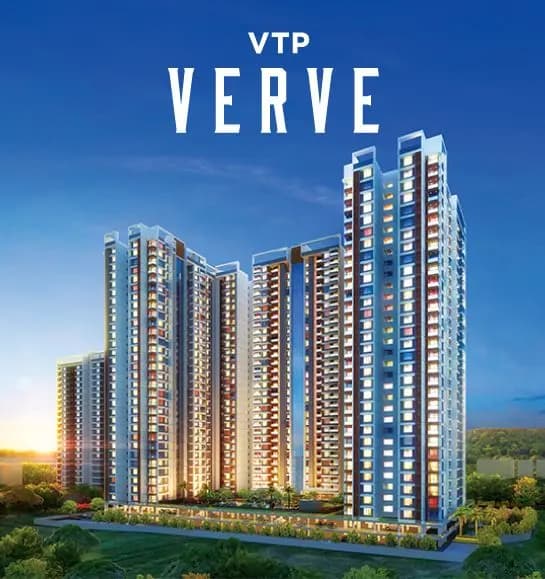
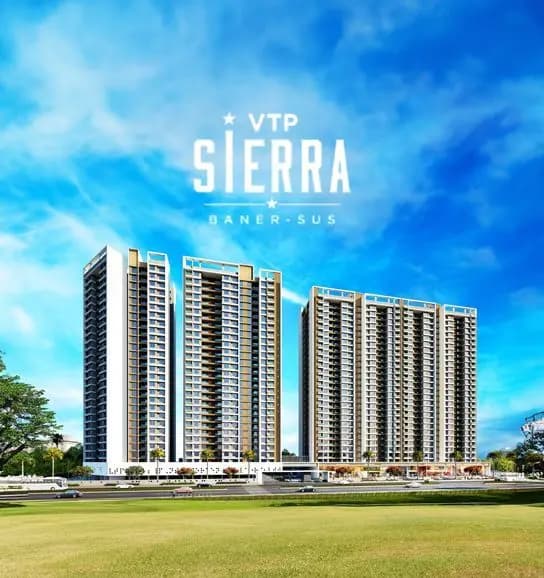
Township Codename Skylights | VTP Verve, VTP Sierra | Panchshil Business Park, Cummins India, Hinjawadi Phase-1 |
| Pune East (New Kharadi) |
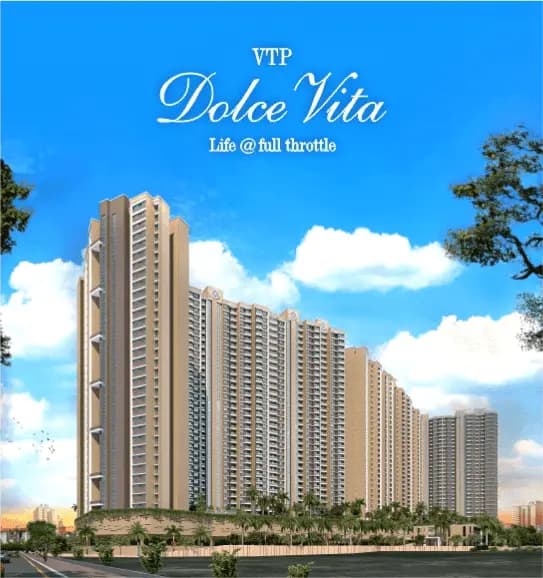
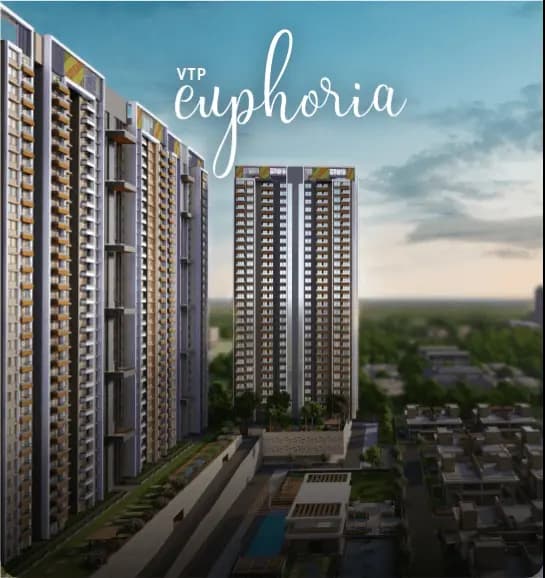
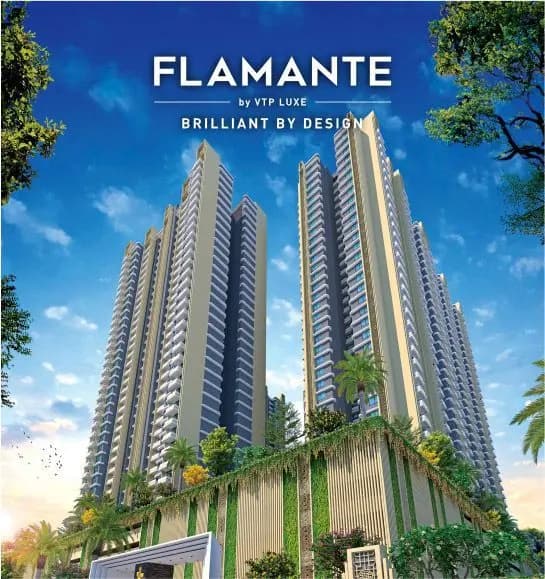
Township Codename Pegasus | VTP Dolce Vita, VTP Euphoria, Flamante by VTP Luxe, Altamira by VTP Luxe | EON IT Park, World Trade Center (WTC), Gera Commerzone |
What Pune’s Next Decade Could Look Like
Pune’s evolution into a technology hub is still underway.
The city is expanding beyond traditional IT services into startups, GCCs, fintech, AI, automotive technology and advanced manufacturing. At the same time, infrastructure is extending the practical boundaries of where people can live and work.
This is likely to create a more distributed Pune business hub rather than a single dominant CBD. Hinjawadi, Kharadi, Baner-Balewadi, Magarpatta and emerging corridors will continue to develop their own employment, residential and lifestyle ecosystems.
For Pune’s real estate, that means the next phase of growth will not simply be about building more homes. It will be about building homes in the right places, with the right infrastructure and the right connection to employment.
Building Pune’s Future with VTP Realty
Pune’s journey from an education hub to a Pune IT hub, technology center, and diversified business destination has fundamentally changed its real estate landscape.
But for a homebuyer, the story should never stop at “Pune is growing.” Growth needs to translate into something tangible: a shorter commute, better infrastructure, stronger employment access, reliable civic amenities, and a home that remains relevant as the city evolves.
For buyers exploring residences, townships, or commercial opportunities in Pune’s fastest-growing corridors, VTP Realty offers projects positioned around the city’s major employment and infrastructure growth stories.
Enquire to explore VTP Realty’s residential and commercial spaces that fit your next move.

RELATED BLOGS



























RECENT BLOGS
LETS GET IN TOUCH