Pune Real Estate Market Trends 2026: Prices, Growth, Forecast & Future Outlook


Table of Contents
- The Evolution of Real Estate in Pune: From Residential Hub to Major Growth Market
- Property Prices in Pune: Where Does the Market Stand?
- Housing Market Trends in Pune: Buyers Are Asking for More Space
- Latest Real Estate Trends in Pune Shaping the Market
- Pune Property Market Trends by Major Micro-Market
- Pune Property Market Growth: What Is Driving Demand?
- Pune Real Estate for NRIs: Why the City Continues to Attract Overseas Buyers
- Pune Real Estate Rental and Commercial Market Outlook
- Pune Property Market Forecast 2026–2027: Prices, Outlook & Growth Areas
- Is Pune Real Estate a Good Investment in 2026–2027?
- The Future of Pune's Real Estate Market
- Frequently Asked Questions
- How VTP Realty Is Changing the Real Estate Landscape in Pune
Pune has changed considerably as a real estate market. ICRA estimates Pune to be the fifth-largest residential real estate market among India’s top seven cities, accounting for 16-17% of the total area sold in FY2026.
What was once largely viewed as a more affordable alternative to Mumbai is now a major residential and commercial destination in its own right. IT parks in Hinjawadi and Kharadi, expanding business districts, improved connectivity, and the city’s established manufacturing base have all contributed to this transformation.
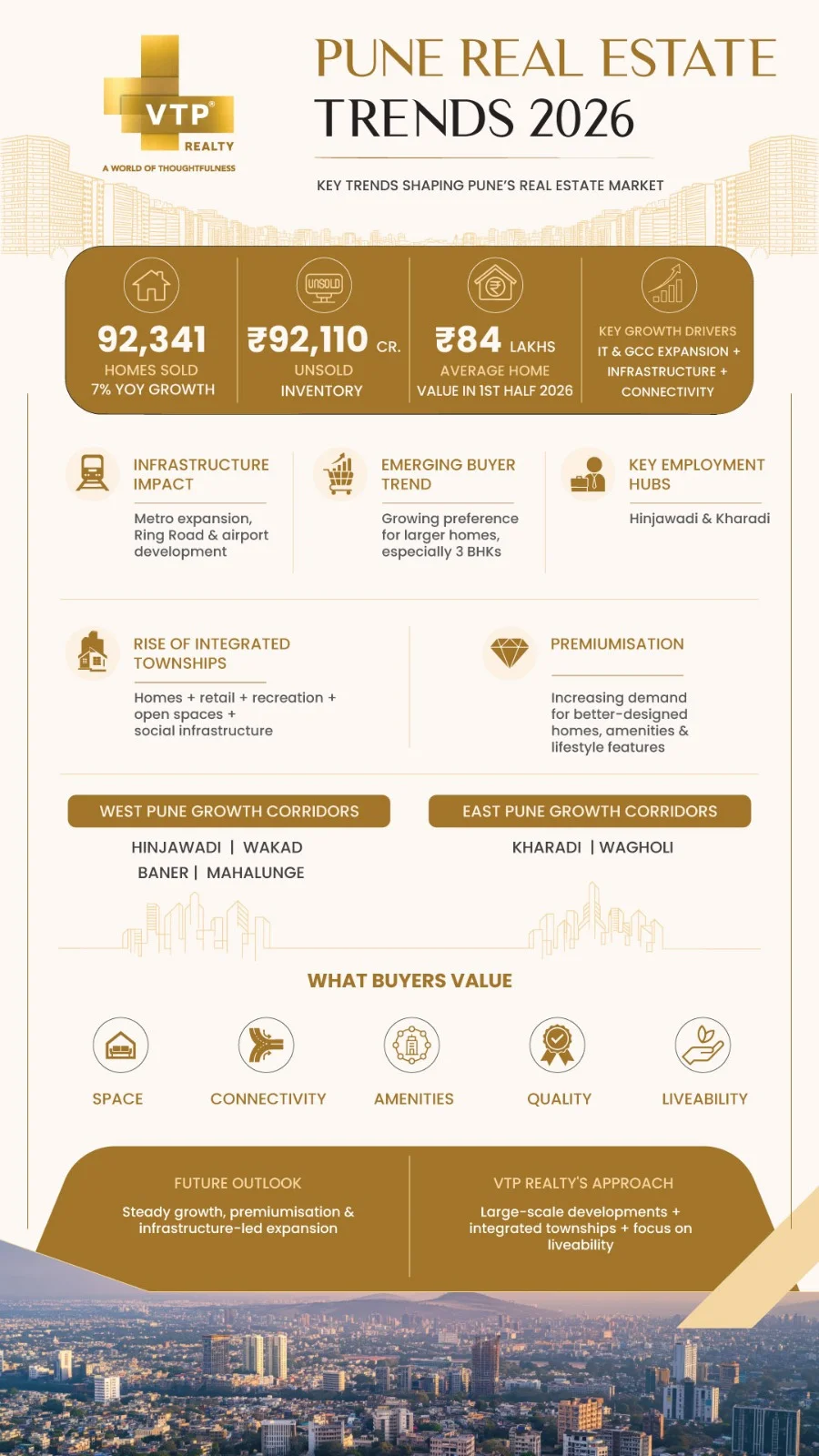
The Pune property market 2026 is also showing an interesting mix of strong demand and increasing supply. Housing sales rose 7% to 92,341 units in the 12 months ending June 2026, according to Hindustan Times. During the same period, residential launches increased 14% to 1,01,085 units. Since new supply is entering the market faster than homes are being sold, inventory overhang has increased from 10.8 to 11.3 months, while the value of unsold residential stock has reached ₹92,110 crore.
At the same time, Pune continues to attract significant buyer interest. H1 2026 recorded 44,265 housing transactions worth ₹37,048 crore, with the average home value reaching ₹84 lakh, according to reports.
So, where is the market headed? And what do the current housing market trends in Pune mean for someone planning to buy a home today? Let’s dive deeper into it.
Pune Real Estate at a Glance
|
Indicator |
2026 Figure |
| Housing sales | 92,341 units |
| Housing sales growth | 7% YoY |
| Residential launches | 1,01,085 units |
| Launch growth | 14% YoY |
| Inventory overhang | 11.3 months |
| Unsold inventory value | ₹92,110 crore |
| H1 2026 homes sold | 44,265 |
| H1 2026 sales value | ₹37,048 crore |
| Average H1 2026 home value | ₹84 lakh |
| Average Pune asking price | Around ₹12,950 / sq ft |
These figures tell a more balanced story than simply calling Pune a booming market. People are buying, developers are continuing to launch projects, but buyers also have more choice than they did a year ago.
The Evolution of Real Estate in Pune: From Residential Hub to Major Growth Market
The evolution of real estate in Pune has closely followed the city’s economic growth.
The eastern side of the city has developed around commercial hubs such as Kharadi, while Hinjawadi has anchored the western IT corridor. Baner and Wakad have grown into established residential destinations, and locations such as Mahalunge and Wagholi are seeing development move further outward.
This expansion has changed how Pune’s property market works. There is no single "Pune market" anymore. Property prices, rental demand, and buyer preferences can vary significantly between two locations just a few kilometers apart.
For instance, a buyer looking at Kharadi may be prioritizing access to major employment hubs and a mature commercial ecosystem. Someone considering Wagholi may be more focused on affordability and the area’s future infrastructure. In Hinjawadi, commute time to the IT corridor can be a much bigger consideration.
That is why understanding Pune property market trends requires looking at individual corridors rather than relying only on city-wide averages.
Property Prices in Pune: Where Does the Market Stand?
Property prices in Pune vary widely depending on the locality, project, configuration, and developer.
Square Yards currently places Pune’s average asking price at around ₹12,000–₹13,000 per sq ft. Its locality-level data shows considerably higher rates in premium areas and more accessible pricing in emerging markets.
These are indicative market ranges rather than a standard rate for every property. A new luxury development and an older resale apartment in the same locality can have very different prices.
The bigger change is in what buyers are willing to spend. CRE Matrix reports that the average home sold in Pune during H1 2026 was valued at ₹84 lakh, up 38% from H1 2022.
That points towards a market where premiumization is becoming increasingly visible, particularly among existing homeowners upgrading to larger properties.
Housing Market Trends in Pune: Buyers Are Asking for More Space
One of the clearest changes in the Pune housing market trends is the growing preference for larger homes.
Rising Demand for Larger Homes
Demand for homes measuring up to 1,000 sq ft has weakened, while residences above 1,400 sq ft have recorded stronger growth, as per Dreams Per Sqft Magazine. The shift is particularly relevant to the 3 BHK flats segment, where buyers are looking for homes that can accommodate family life, work-from-home requirements and additional personal space.
The change is not difficult to understand. A home today may need to accommodate a home office, children’s study area, guests, storage and leisure space. Buyers are therefore paying closer attention to the actual usability of a layout rather than simply comparing the number of bedrooms.
The rise in higher-value transactions supports this trend. Sales of homes priced above ₹2 crore increased 220% compared with H1 2022, according to CRE Matrix.
That does not mean Pune has suddenly become a luxury-only market. It means the upper end is growing faster, while buyers across segments are becoming more conscious about space, design and the overall quality of the development.
Premiumization of Residential Real Estate
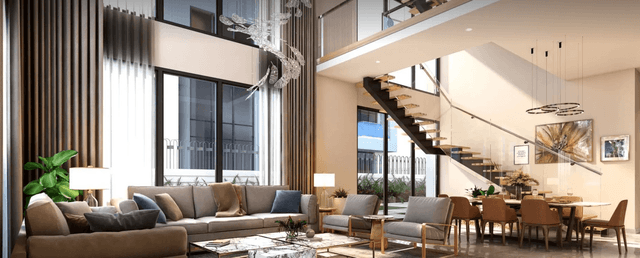
A key housing market trend in Pune is the shift towards better-designed, larger residential spaces with stronger amenities. Buyers are increasingly willing to pay for quality, usable space, lifestyle features, and well-connected locations rather than choosing purely on price. This has strengthened demand for premium homes, particularly in established and emerging employment corridors.
Rise of Integrated Townships
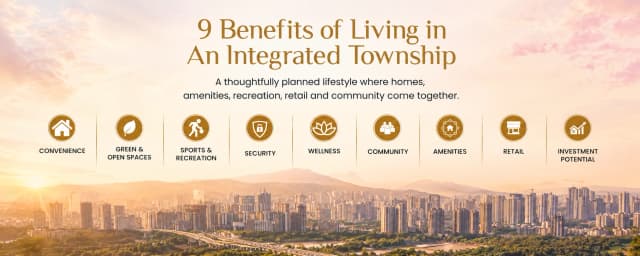
Pune housing market trends also point towards growing interest in integrated townships that bring homes, retail, recreation, open spaces and social infrastructure together. These self-contained communities offer greater convenience and are particularly appealing to families looking for a more complete lifestyle within a well-planned development.
Latest Real Estate Trends in Pune Shaping the Market
Infrastructure-Led Property Growth
Infrastructure is reshaping Pune’s residential map. Metro lines 1, 2, and 3 expansion, road upgrades, Ring Road development, and Purandar airport are improving access between emerging residential areas and key employment hubs, making connectivity an increasingly important factor in property decisions.
Employment-Led Housing Demand
Pune’s strong IT and GCC ecosystem continues to support housing demand. Hinjawadi and Kharadi remain key employment anchors, creating steady demand for homes and rentals in surrounding areas. As employment centers expand, nearby residential corridors are seeing greater absorption.
Sustainable and Smart Homes
Sustainability is moving from an added feature to a stronger consideration for buyers. EV charging, energy-efficient systems, solar integration, smart-home technology, and green spaces are increasingly being integrated into modern residential developments.
Amenities Becoming a Buying Factor
Amenities now influence buying decisions alongside location and configuration. Clubhouses, fitness and recreation facilities, open spaces, co-working or study areas, retail and everyday conveniences are helping developers create communities designed around modern urban lifestyles.
Smart Automation Integration
VTP Realty’s future-forward housing integrates smart home automation features across its residential projects in Pune, allowing residents to control home appliances and security systems via mobile applications — a leap in the Pune real estate future.
Pune Property Market Trends by Major Micro-Market
Looking at Pune’s property market trends by corridor gives a clearer picture of where demand is coming from.
Kharadi and East Pune
Kharadi has become one of Pune’s strongest employment-led residential markets, supported by major commercial developments and GCC activity. The combination of jobs, housing and social infrastructure has helped create a relatively self-sustaining ecosystem.
Hinjawadi, Wakad and West Pune
Hinjawadi remains one of Pune’s most important IT destinations. Wakad benefits from its proximity to the employment corridor while offering a broad residential market. The western belt continues to attract professionals as well as families looking for established amenities.
Baner and Mahalunge
Baner occupies a more established premium position, while Mahalunge is benefiting from the continued outward expansion of West Pune. Large residential developments are changing the character of the corridor.
Wagholi
Wagholi remains relevant to buyers seeking comparatively affordable home prices in East Pune. Its long-term trajectory will depend on infrastructure, connectivity and the balance between new supply and actual demand.
Pune Property Market Growth: What Is Driving Demand?
Pune’s real estate growth is being shaped by a combination of employment, infrastructure and steady urban expansion. These factors are creating new residential demand while strengthening established property corridors.
IT, GCC and Corporate Expansion
Pune’s expanding IT and GCC ecosystem continues to support both residential and rental demand. As office activity grows in hubs such as Kharadi and Hinjawadi, housing demand is also strengthening in surrounding neighborhoods, particularly among working professionals.
Pune Metro and Improved Connectivity
Metro expansion is improving access between residential neighborhoods and major employment centers. Better public transport gives buyers more flexibility in choosing where to live, making connectivity and commute convenience increasingly important considerations.
Road and Peripheral Infrastructure
Road upgrades and projects such as the Pune Ring Road are supporting the city’s outward expansion. Improved access can make emerging corridors more viable for residential development and more effectively connect them to established parts of Pune.
Manufacturing and Industrial Growth
Pune’s established automotive, engineering, and manufacturing ecosystem provides an additional employment base beyond IT. This economic diversity supports housing demand across a wider range of locations and buyer segments.
Population and Urban Expansion
As Pune’s employment base and urban footprint expand, housing demand is extending beyond traditional neighborhoods. Emerging corridors are increasingly becoming part of the city’s residential landscape, creating opportunities for new communities and large-scale developments.
Pune Real Estate for NRIs: Why the City Continues to Attract Overseas Buyers
- Strong employment and economic fundamentals: Pune’s IT, GCC, manufacturing, and education sectors support long-term housing demand, making the city relevant to NRIs seeking a property market with established economic drivers.
- Growing premium housing demand: Rising demand for larger homes, integrated townships, and lifestyle-led developments can appeal to NRIs seeking a future family house or a premium residential asset.
- Key locations to watch: Kharadi, Hinjawadi, Baner, Mahalunge, and other employment-led corridors offer distinct propositions in terms of connectivity, pricing, and development maturity.
- Rental potential: Proximity to IT parks and employment hubs can support tenant demand, though rental yields, vacancy rates, and property management costs should be assessed before purchase.
- Ease of remote ownership: Established developers, transparent project documentation, and professional property management services can make the ownership process more manageable for buyers living overseas.
- Due diligence for NRI buyers: Cover MahaRERA registration, title and approvals, developer track record, payment processes, taxation, and applicable NRI property regulations. For tax or legal matters, professional advice should be obtained.
- Future outlook: NRI demand is connected to the broader Pune real estate outlook, particularly premiumization, infrastructure development, and the expansion of integrated communities.
Learn more about VTP Realty® Projects for NRI Investment in Pune
Pune Real Estate Rental and Commercial Market Outlook
Residential Rental Market
Pune’s rental market also benefits from its large working population.
Residential rental yields generally fall below 5%, though actual yields vary with purchase price, rent, vacancy rate, and property type, according to Rentgraphy.
Commercial property typically offers higher yields, with the broad range cited for Pune. These reported figures should be treated as market indicators rather than assured returns.
The distinction between residential and commercial real estate is important. Residential demand is largely driven by end users and tenants, while commercial performance depends on factors such as tenant quality, lease structure, occupancy and operating costs.
For Pune, however, both markets benefit from the same underlying factor: economic activity.
Commercial Real Estate
Pune’s commercial market continues to support its residential growth, with 5.31 million sq ft of gross office leasing recorded in H1 2026. GCCs and flexible workspace operators remain key drivers of demand, particularly across established business corridors.
As companies expand and create new employment opportunities, demand for nearby housing and rentals follows. This connection between office growth, workforce expansion, and residential absorption continues to strengthen Pune’s overall real estate market.
Pune Property Market Forecast 2026–2027: Prices, Outlook & Growth Areas
Pune’s property outlook remains positive, but the next phase of growth is likely to be more selective. Strong employment, infrastructure development, and continued housing demand can support the market, while rising supply means individual locations and projects may perform differently.
Pune Property Market Outlook (2026–2027)
According to Pune Realty Hub, the residential market in Pune is at a historic high, with approximately 58,000 registered units. Key zones experienced an 8–9% year-on-year increase in average prices, led by strong performance in West Pune. Additionally, inventory-to-sale ratios in premium corridors have dropped to 14–16 months, down significantly from 24–36 months in 2019, reflecting stronger market absorption and healthier fundamentals.
While the overarching outlook for Pune real estate stays positive, future expansion is expected to be increasingly selective. Steady employment opportunities, major infrastructure upgrades, and sustained housing demand will continue to underpin the market.
However, as new project launches expand available supply, performance across specific locations and developments will vary.
Projected Price Trends and Valuation
Annual property appreciation in Pune is projected to maintain an upward trajectory. Market trajectories will likely diverge based on location dynamics: mature neighborhoods backed by strong commercial ecosystems and established social infrastructure are poised to perform differently from peripheral markets where new inventory continues to accumulate.
Will Pune Property Prices Continue to Rise?
Property prices in Pune are broadly expected to see an increase in annual appreciation. Established locations with strong employment access and social infrastructure may follow a different trajectory from emerging markets where supply is still building.
Which Areas in Pune Could Outperform?
The strongest potential is likely to remain in locations where employment, connectivity, and residential development come together. Metro-connected areas, IT corridors such as Hinjawadi and Kharadi, and large gated communities could remain attractive. Emerging Eastern and Western suburbs may also benefit as road and infrastructure networks improve, although their growth will depend on infrastructure delivery, demand, and supply levels.
Is Pune Real Estate a Good Investment in 2026-2027?
Pune continues to attract homebuyers and investors, but the right property depends on the buyer’s objective, budget, and holding period. Rather than viewing the city as a single market, it is useful to assess individual locations based on demand, connectivity, infrastructure, and pricing.
For First-Time Homebuyers
For first-time buyers, affordability, connectivity, and future infrastructure are key considerations. Areas offering access to employment hubs without stretching the budget too far can be attractive. Developer credibility, project approvals, and delivery track record should also be assessed carefully.
For Homebuyers Seeking Long-Term Liveability
End homebuyers can focus more closely on configuration, livability, and everyday convenience. A well-planned 2-, 3-, or 4-BHK house with quality amenities and proximity to workplaces, schools, healthcare, and retail can have a greater impact on long-term satisfaction than the headline price alone.
Read more on Why VTP Realty is a Smart Choice for Buyers for 2BHK, 3BHK Flats in Pune
For Rental Investors
For rental-focused buyers, proximity to IT parks, GCCs and other employment hubs can support tenant demand. In Pune, rental yields, prevailing rents, vacancy levels, maintenance costs, and tenant profiles should all be considered when assessing a property’s rental potential.
For Long-Term Investors
Long-term investors may look at areas supported by infrastructure pipelines, population growth and employment expansion. Entry pricing remains equally important, as future development does not automatically translate into higher property values. Micro-market fundamentals and the quality of the individual project should remain central to the assessment.
The Future of Pune’s Real Estate Market
The growth of real estate in Pune is being shaped by three clear forces: expanding employment hubs, improving infrastructure and changing buyer expectations. IT and GCC expansion is strengthening residential demand along key corridors, while metro and road connectivity is opening up new parts of the city.
At the same time, Pune’s housing market is becoming more selective. Buyers are looking beyond price to assess location, connectivity, home design, amenities, developer credibility and long-term liveability. With supply also expanding, not every project or locality is likely to follow the same trajectory.
This makes a micro-market approach increasingly important. Kharadi, Hinjawadi, Baner, Mahalunge, Wagholi, and other corridors each have distinct demand drivers, infrastructure profiles, and price points.
Looking ahead, Pune’s real estate future is likely to be defined by steady growth, premiumization, and infrastructure-led expansion, with greater demand for well-planned, connected communities that offer more than just a home.
Frequently Asked Questions
Which areas could shape Pune’s real estate future?
Established hubs such as Kharadi, Hinjawadi, Baner and Wakad are likely to remain important, while areas such as Mahalunge, Wagholi and Moshi are likely to experience further growth as infrastructure and residential development expand.
What will homebuyers want by 2030?
Homebuyers are likely to look for larger homes, better amenities, green spaces, smart features and good connectivity. Integrated townships and well-planned communities could become increasingly popular as people place greater value on convenience and overall quality of life.
What will drive Pune’s real estate growth in the next five years?
Pune’s future real estate growth will be driven by IT and GCC expansion, new infrastructure, better connectivity, and population growth. As more jobs and businesses move into emerging corridors, demand for nearby housing is likely to increase.
How VTP Realty Is Changing the Real Estate Landscape in Pune
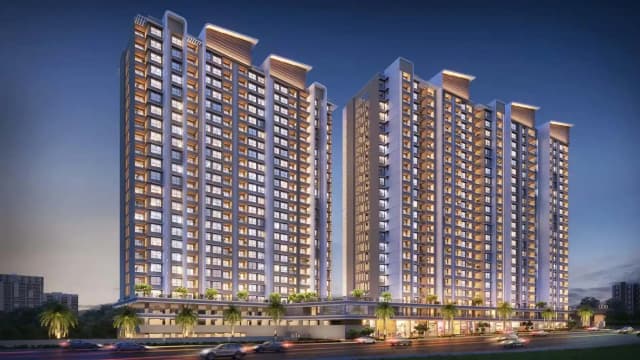
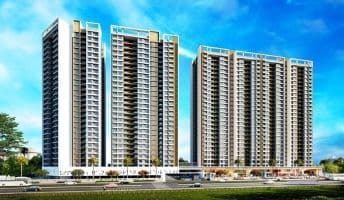
VTP Realty projects reflect the evolving real estate market in Pune, with a focus on large-scale residential developments, integrated VTP townships and homes designed around everyday living. Our presence across growth corridors such as Kharadi, Mahalunge and Hinjawadi aligns with the wider expansion of Pune’s residential market.
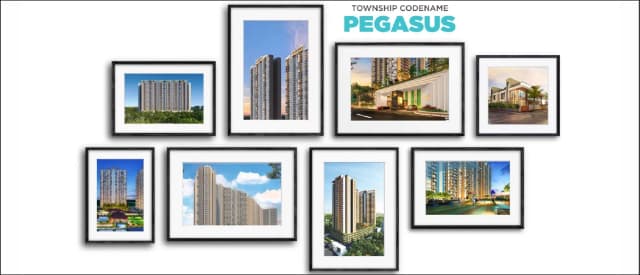
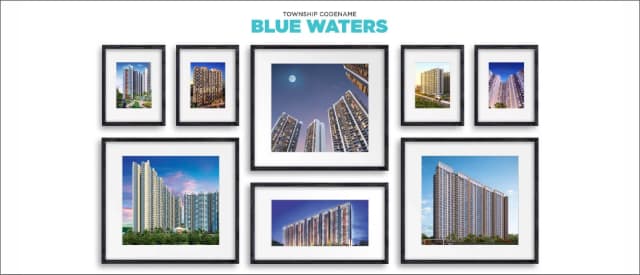
Its township-led approach brings together homes, open spaces, amenities, retail and community infrastructure, creating more complete living environments rather than standalone residential projects. The Maximum Livable Area (MLA) philosophy further focuses on making homes more functional, with greater emphasis on usable space and efficient layouts.
This approach aligns with several of the latest real estate trends in Pune, including premiumization, larger configurations, lifestyle-led amenities, connectivity, and integrated communities. By developing at scale in emerging corridors, VTP is also contributing to the growth of new residential ecosystems.
[Quote by VTP Realty to be inserted here]
As the Pune property market 2026 becomes more discerning, the focus is increasingly shifting towards quality and liveability. VTP’s development model reflects where Pune real estate could be headed: connected communities, better use of space, and residential environments designed around how people actually live.
Looking to invest in Pune’s real estate?
Explore VTP Realty’s residences and commercial projects, and enquire today to find a space that fits your aspirations.


RELATED BLOGS



























RECENT BLOGS
LETS GET IN TOUCH